 Sesriem Canyon, Sossusvlei and Deadvlei
 Introduction
The Tsauchab river drains the area south of the Naukluft Mountains. Near to the Sesriem Camp site, it drops into the Sesriem Canyon where it carved a narrow, kilometer (0.6 mile) long and up to 30-meter (100-foot) deep canyon in sedimentary rock and then continues another 65km until it is stopped by the red dunes of the Namib Desert. At this point it formed several white clay pans, of which the best known are Sossusvlei, Deadvlei and Hiddenvlei. The Tsauchab river is normally dry, but after heavy rains the water reaches Sossusvlei where it fills the pan. This normally happens only once in a decade, but in 2010, 2011 and 2012 the water reached Sossusvlei. Deadvlei and Hiddenvlei have been cut-off from the river by dunes and receives no water. Deadvlei is famous for it's many dead tree skeletons. Access to the pans is via a 55km tarred road from the Sesriem entrance gate to the parking area 5km from Sossusvlei. From there it is a 4x4 route through thick sand. A shuttle service for those without 4x4's are available at the parking area for N$100 per person. Do not try to do the trail with a 4x2. I tried...Deadvlei
From the parking area at the end of the tarred road, it is a further 4 km drive through thick sand to the parking area near Deadvlei. Deadvlei is a further 1.1 km walk through thick sand. Deadvlei is a photographer's dream. The many dead tree skeletons are estimated to be more than 900 years old. They are being preserved by the dry air. Climb the dune on the left for a spectacular view of the area and continue up to the top of Big Daddy, which is said to be the highest dune on earth (only for the very fit).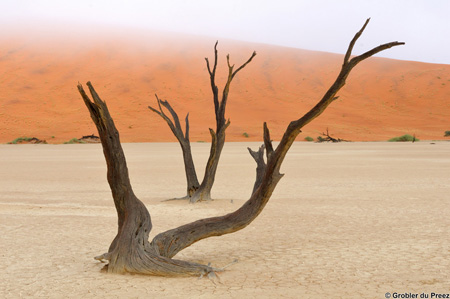
Hiddenvlei
Hiddenvlei is a 3.5 km walk in a south-westerly direction from the Deadvlei parking area. It is completely surrounded by high dunes.Sossusvlei
The parking area right next to Sossusvlei is a further 1 km away from the Deadvlei parking area. Huge Camelthorn trees provide shade. Walk up the sickle-shaped dune on the right hand side of Sossusvlei for a panoramic view of the area.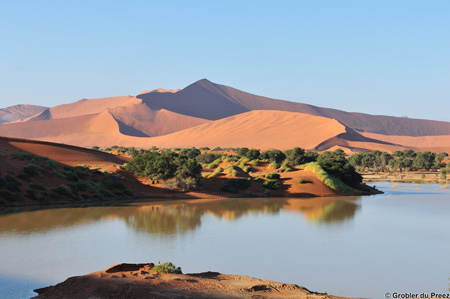
Dune 45
Dune 45 is situated 45 km fron the Sesriem entrance gate and is probably the most photographed dune in Namibia.
Sesriem Canyon
On the map: use the arrows on the map - 8 clicks down from the home position The canyon starts as a 30 cm wide gap and gradually widens over the next 1 km. Walk approximately 100 m upstream from the parking area to find the start of the canyon. From the parking area, a footpath and stairs lead into the canyon. Turn left at the bottom to reach the pool from which earlier trekkers replenished their water supplies. Ses (six in Afrikaans) rieme (straps made from ox hides) were used tied together to reach the water from above.
Photography tips
TimingThe landscape inside the park is the most beautiful at sunrise and sunset. The colours of the dunes changes dramatically as the sun rises / sets. Be at Deadvlei or Sossusvlei before the sun rises. Visitors camping at the NWR resort at Sesriem are allowed to enter the park one hour earlier and leave one hour later than those staying outside the park. Visitors staying outside the park will not be in time for sunrise. Unfortunately, due gate times, it is not possible to be at Deadvlei or Sossusvlei when the sun sets whether you stay at NWR Sesriem or outside of the park. Visitors sleeping at the Sossus Dune Lodge near Sesriem Canyon have unrestricted access to the park, but at a price ~20x that of NWR Sesriem. At sunset. if you aren't staying at Sossus Dune Lodge, but at NWR Sesriem, be at Dune45 (45km from the gate), or at another unnamed dune 40km from Sesriem, similar to dune 45, or at Elim Dune 5km from Sesriem. You should have enough time to get to the gate if you leave just before sunset. Visitors from outside of the park could visit Elim Dune at sunset. Please take into account that the speed limit in the park is 60km/h.
Visit Sesriem Canyon when the light is soft or else you will get deep shadows and washed out patches on your photos. Best time is sunrise, sunset or when cloudy. You do not have to pass through the entrance gate to the park to visit the canyon, so it should be possible to visit it during night time also (at least fot the people staying atNWR Sesriem. I am not sure whether the gate between NWR Sesriem and the public road get closed at nigth time.
Equipment
Use a tripod at all times to ensure sharp photos, even if you use a cheap point and shoot camera. You will see the difference. If possible, use a remote trigger or use the camera timer to further reduce camera shake. Even a cell phone camera could take much better photos if you use some sort of support to stabilise it. Wide angle lenses work best: 12-24mm, 14-24mm, 18-200mm, etc. During my last visit I used my 24-70 f2.8. To get the bigger picture, I used a sturdy tripod to shoot several overlapping photos and stitched them together in Photoshop to make a panorama. There is no need to use a high ISO if you use a tripod.
The best photos
Oryx and Springbok between the dunes or next to the road
The dead trees against red dunes or white clay floor
Small insects on the dunes
The mud patterns
Birds on the dead trees, clay patterns or dune
Dune tops covered by mist
Use people in some photos to convey the scale of the trees and dunes
Get on your knees or even lay down flat to get a different angle
Try some photos of the dead trees against the sun (sunset/sunrise only or else your eyes might get damaged)
For more inspiration please see the high quality photo gallery (on the menu bar)
Access Permit 
Access to the park is via a gate at the Sesriem NWR offices. The gate has specific opening and closing times determined by sunrise / sunset. Visitors camping at Sesriem NWR may enter one hour earlier and leave one hour later than visitors staying outside of the park. A permit, obtainable at the offices, is needed to enter the park. Please note that the permit office closes earlier than reception. If you are too late to get a permit, you may still enter the park by leaving the driver's passport at the entrance gate. To get the passport back, you must buy a permit and show it to the gate attendant.Although you need the permit to visit Sesriem Canyon, you do not pass through a control gate.
Accommodation at Sesriem
Please see "Photography tips -> Timing" at the top of this page for guidelines on where to stay if you are a photographer.
1. Sesriem (NWR, Namibia Wildlife Resorts)
2. Sossus Dune lodge (NWR)
(researched information)
3. Sossus Oasis Camp Site
(researched information)
4. Sossusvlei Lodge
(researched information) 

On the map: Sesriem NWR reception is just above where the B1 and the white road meet and the camp site above that.
Residents may depart to Sossusvlei Deadvlei one hour earlier than those staying on the outsiede of the park and arrive back one hour later.
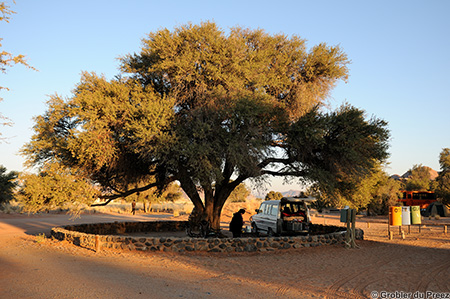
24 camping sites, each with it's own Camelthorn tree, tap with drinkable water and power point (240v), communal toilets and hot showers
Favorite with overlander trucks, often more people than the ammnities could handle, insufficient hot water for peak times.
On the map: use the arrows on the map - 4 clicks left and 5 down to see Sossus Dune lodge to the left of the mountain.
Excellently situated with unrestricted access to Sossusvlei, Deadvlei
23 x desert chalets (2 beds) and 2 x honeymoon suites
Restaurant, Bar, Souvenir Shop, Swimming pool
On the map: Sossus Oasis Camp is at the bottom right hand side
The Sossus Oasis Camp Site offers 12 shaded luxury camp sites not far from the entrance gate to Sesriem and Sossusvlei. Each site has its own toilet, basin, hot/cold shower, barbeque, kitchen wash-up facility and electricity.
On the map: Sossusvlei Lodge is in the right hand top corner.
45 accommodation units fully air-conditioned with a shower, toilet and wash basin. Situated just outside the entrance gate to Sesriem and Sossusvlei.
View Larger Map
5. Other accommodation in the vicinity
Many lodges and camp sites are available, but please keep in mind the recommendations under "Photography tips -> Timing" at the top of this page for guidelines on where to stay if you are a photographer.
How to get there
From Walvisbaai; C14 -> C17 -> C27 (first 18 km tar, then all gravel)(315 km)
From Aus: C13 -> C27 or D707 (more scenic)(gravel from Aus)(342 km)
From Keetmanshoop: B4 -> C14 -> Helmeringhausen (gravel from Bethanie)
From here there are three options:
-> C13 -> D707 (more scenic)(463 km) or
-> C14 -> C19 -> C27 (490 km) or
-> C14 -> D891 to Duwiseb Castle -> D826 -> C27 (485 km)
From Windhoek: B1 to Rehoboth -> C24 -> C24 West -> C19 -> C27 (351 km)
(gravel from Rehoboth) or take B1 to Mariental
From Mariental: C19 via Maltehohe -> C27 (gravel from Maltehohe)(282 km)
Road advisory
The last 40 km of the C14 from Walvisbay to Solitaire is normally very badly corrugated.
Shops, fuel and emergency services
Fuel available at Sesriem NWR (accept garage cards) and
at the entrance to Sossus Oasis Camp Site (cash only)
Shops with basic food and curios at the NWR offices in Sesriem and at the garage at the entrance to Sossus Oasis Camp Site
When to visit
Best to visit during the cooler months (April to August). During summer months it gets very hot.